(Note: the following is one of various posts that were copied here from the Moonwards.com forum for the sake of preserving the early days of the project. It was originally posted there on Nov 7thth, 2015.)
I redid a few things around the website over the last week, and finally i got to the 'about' page. I'd just thrown something on it when i built it. (Which got republished in the NSS newsletter as an announcement of the creation of Moonwards - not what i'd planned.) I take mission statements pretty seriously. I spent hours redoing it. If you want to convince non-space-nerds that a Moon colony is anything but an extravagant luxury, you really have to nail it.
'Why' - that is the name of the page in the menu now. The summary at the top is about a page long and hits all my major points, which are also some of my major buttons. If i start to get on the subject in a conversation i can really go off. The page needs to be more than that of course. I think i'll add a resources section to it, and a sort of snippets section. After i learn the jQuery to do it the way i want or find a plug-in that fits the bill. For now it has a graphic i did for the International Lunar Decade movement, that's it.
But i'm trying to decide how i can rant on that page a bit in a useful way, too. People who know me know i hold the Dark Side of the Moon in reserve. If you seem open-minded, or i'm already off on a tirade, i'll explain to you how even a pretty small Moon colony of a few hundred people could conquer the entire world. (Explained here if you're interested. Pretty straight-forward, really.) If the happy argument of why Moon settlement matters doesn't work, the scary one, i figure, ought to do the trick. I have encountered disagreement on this. I don't understand that. Yes, i too feel a little skittish about trotting it out because it is just so outside the realm of anything normally discussed as realistic planning for the future. But, it could be done. That matters, right?
Anyhow... the disjoint between what is possible now and what we actually spend our time thinking about just seems weirder to me the more i ponder it these days. Not an issue evolution has equipped us for, sure. Maybe our smartphones will change our conditioning in time for us to give the flood of new possibilites something approaching the weight they deserve in the near future. It's high time for space settlement to come in from the cold.

What could be done, starting today, if a group of nations were determined to colonize the Moon, and they based their decisions only on technical and economic merit?
Friday, July 22, 2016

Why this isn't being placed at the poles
(Note: the following is one of various posts that were copied here from the Moonwards.com forum for the sake of preserving the early days of the project. It was originally posted there on Nov 7thth, 2015.)
The Lunar poles are all the rage, especially the South Pole and Aitken Basin. There is now good evidence that there is a lot of water ice trapped in permanent darkness there. That ice also contains carbon monoxide and nitrogen. Those volatiles can be put to excellent use on a lunar base.
There are also the Peaks of Eternal Light, which don't quite live up to their utopian names, but still have daylight about 80 to 90% of the time. That makes the power supply much less of an issue and evens out temperatures. Those are pretty big advantages, so why have i placed the VMC at the equator, where the nights are long and harsh and water can only be had from Earth?
The main point is the poles should be home to the second base, not the first. Getting that water and other stuff is not going to be easy at all. They are in extremely cold places, kilometers below the sunny spots where a base would be. What form they come in is far from clear, but they are probably not more than 5% of the ground material in those shadowed hollows. To collect them in significant quantities will require a lot of infrastructure. They couldn't be used to supply an inhabited base for years, while all that is built and gotten rolling. Once it is rolling, the idea is it supplies the income that justifies that - you split the water into oxygen and hydrogen and sell it as rocket fuel. I have serious doubts there.
That much infrastructure could also be used to create industrial scale production of oxygen at the equator - or anywhere else for that matter, the Moon is almost half oxygen. Oxygen is most of the mass of propellant, so it is still a major advantage to future missions if they can get supplies of it in space. Also it is very far from certain that the market for propellant will spring up nicely just when you need it. Basing the economic model of a settlement on a market that doesn't exist strikes me as a bad idea. I understand the temptation, but i think it is misguided.
If you aren't mining it for profit there is no reason to mine it at all. It is much easier and more reliable to ship the water and nitrogen you need for the early phase of human settlement from Earth. Enough for 10 or 20 people can come up on one or two rockets. As life in space gets going, you can start mining those resources when the right moment arrives, and in the meantime, you can scout and study those areas thoroughly. And you can keep scaling up your oxygen production, there at the equator, using infrastructure already created for production of building materials and pure metals and metal oxides. Then you can sell LOX, with much less up front investment, and scale production smoothly as the market develops. When you finally decide to mine the poles, it could well be mostly to get water and nitrogen for a quickly expanding colony, not to sell as propellant. Also remember that once we go poking around under the lunar surface, via lava tubes or simple mining of the bedrock, there will be surprises. One of them could be volatiles trapped in bubbles and tubes that have been sealed for millions or billions of years. If so, those deposits could be much simpler to tap.
How about the handy near-constant sunlight? I'm not that impressed. Temperature fluctuations are not a big deal with this construction method, it gives you lots of thermal mass quickly, in the domes and galleries themselves and much more so in the thermal connections they form with mega-regolith through the foundation. We are talking about building at scale, in that situation including energy storage systems for the nights isn't that hard. I've already gone on about storage of potential energy in the form of boulders lifted and lowered, and Joe has mentioned the other options of flywheels or batteries, or just sticking to nuclear for power available all the time. The amount of extra infrastructure that involves is a good deal for what you get in exchange: basalt, KREEP, and easy access.
There is no basalt within 1000 km of the poles. The dome construction technique being proposed right now would still work with highland regolith, but you won't be making rope or cloth out of it. Anything that needs to be flexible has to come from Earth, which includes composites that contain fiber layers. Over the long term that really sucks.
Phosphorus, potassium - absolutely essential, great to have nearby, and only found in KREEP deposits, which are only in Oceanus Procellarum. Those deposits also come with concentrations of thorium, and uranium too. Long term, that means nuclear reactors for energy would be an option, and more importantly, nuclear rockets. You want to open up space? Nuclear thermal rockets without the politics sound pretty awesome.
Also evacuation from the equator is easier than from the poles. If you have people there, you really want to have the option of launching at any time. At the equator you can do that with a smaller, less expensive rocket because you can keep an upper stage in orbit and rendezvous with it within an hour or two at any time. That trick only works at the poles every two weeks. The fuel to the equator is also less, which means bigger payloads.
So, that's why. If you say that means there is no business case for settling the Moon, well, let me come back to that.
Big picture?
(Note: the following is one of various posts that were copied here from the Moonwards.com forum for the sake of preserving the early days of the project. It was originally posted there on Oct 27th, 2015. The first part was a post by Joe Strout, of the High Frontier space colonization game, and then follows my response.)
Heya Joe - i'm sorry, i didn't see this entry until just now. I've been taking it easy this week after a few months of rather intense work. Normally i keep the forum open in a tab all the time, but not this week.
To some degree, i'm feeling my way forward. As i think things through, i become less sure of the best way for this to grow, and so i don't want to lay out a plan that is too specific. Many options and off-branches have occurred to me. I have this feeling that the lay of the land is about to drastically change, in the space advocacy scene. SpaceX, the Chinese, a Russia renewing its nationalist space drive, cubesats, India moving forward, talk of a venture capital fund, 3d printing, Bigelow... things are burgeoning towards a major tipping point. The options for making the case for how critical space development is, is moving almost as fast. There is a lot to think about.
As i finish the basic website, which i think i have to do before i make any kind of move to involve more people formally, i am considering what the best path is. Input is of course welcome. What i'm making right now is the calling card for when i ask people with the right skills to think about contributing. That i have to do on my own. I have a plan, and it should take me a few more months. Let's say by sometime in February. What you see right now is maybe a tenth of what is in my head. I need a complete rough draft based on my own ideas, many of which will later be modified or replaced when informed input comes in, but at least it will all hang together as one integrated vision. That i think is critical so i want it to have that presence from the start. Also the layout and interactivity of the site needs a lot of work, i can do better.
Then? I'll seek people through the Blender community who would be interested in building more involved, complete models in exchange for having a window pop up, in the eventual 3d environment the whole thing will be in, whenever a special kind of button is pressed, which each model will have. In that window, the people who built it get to post a short write up and a few images, and put their logo and contact info.
I'll seek sponsors who will help convince Blender and app-programmer types that such a deal will work for them because this thing will likely get enough traffic for that to genuinely be a networking tool.
I'll go into the NSS community very actively searching for a few people who can help put the website completely in shape to be a high-traffic site that can administer the teams involved. And also seeking NSS introductions to organizations who could be sponsors.
I don't think that turning this into a game is a good approach, at least not in the sense several other organizations are working on - including yours. That has its merits but it is being covered. I want this to have very broad appeal and be a platform for discussion. I have ideas about how to make it layered so that people can get the level of education they want as they interact with the environment, and mostly enjoy experiencing it. The idea is more like Minecraft or Sims than a goal-oriented game. And playing with the models would be entirely optional, you could just look around and click on things as you wish to find out about them, or click once to be taken on a walk-through.
Backing it up, for those who are so inclined, would be an entrance to this forum (or rather it's more developed successor), tucked in a few places around the virtual colony. There visitors would see the top threads displayed and could open it in a new tab. However they would need to have thoroughly checked through the virtual colony and completed several tasks in order to gain access to the forum. Perhaps in that forum, or maybe in a connected blog or some such thing, i'll probably go on occasional tirades about how very important this all is. It will be in the process of reaching beyond this planet in a serious way that we learn to identify ourselves as one species, on one of many planets, in a vast universe in which our previous ideas of cosmic truth are too limiting and must be expanded.
I apologize if this is explained somewhere, and I missed it.
I'm very impressed with the quality of what's going on here, and fully supportive of the goal as I understand it. But I'm a little vague on exactly what that goal is.
I see that you're designing an expandable base near Lalande crater. You also talk about making a virtual base that people can play with, I guess as a computer game.
Can you expand on the objective & plan there? What will this game be like? Who will create it?
And, are there further objectives beyond the game? E.g., would we be advocating this lunar plan to major governments or large corporations, the way Robert Zubrin has been pushing his Mars Direct plan for many years?
I guess I'm just looking for a little clarification as to what we're trying to do here, and how we intend to accomplish it.
Thanks, - Joe
Heya Joe - i'm sorry, i didn't see this entry until just now. I've been taking it easy this week after a few months of rather intense work. Normally i keep the forum open in a tab all the time, but not this week.
To some degree, i'm feeling my way forward. As i think things through, i become less sure of the best way for this to grow, and so i don't want to lay out a plan that is too specific. Many options and off-branches have occurred to me. I have this feeling that the lay of the land is about to drastically change, in the space advocacy scene. SpaceX, the Chinese, a Russia renewing its nationalist space drive, cubesats, India moving forward, talk of a venture capital fund, 3d printing, Bigelow... things are burgeoning towards a major tipping point. The options for making the case for how critical space development is, is moving almost as fast. There is a lot to think about.
As i finish the basic website, which i think i have to do before i make any kind of move to involve more people formally, i am considering what the best path is. Input is of course welcome. What i'm making right now is the calling card for when i ask people with the right skills to think about contributing. That i have to do on my own. I have a plan, and it should take me a few more months. Let's say by sometime in February. What you see right now is maybe a tenth of what is in my head. I need a complete rough draft based on my own ideas, many of which will later be modified or replaced when informed input comes in, but at least it will all hang together as one integrated vision. That i think is critical so i want it to have that presence from the start. Also the layout and interactivity of the site needs a lot of work, i can do better.
Then? I'll seek people through the Blender community who would be interested in building more involved, complete models in exchange for having a window pop up, in the eventual 3d environment the whole thing will be in, whenever a special kind of button is pressed, which each model will have. In that window, the people who built it get to post a short write up and a few images, and put their logo and contact info.
I'll seek sponsors who will help convince Blender and app-programmer types that such a deal will work for them because this thing will likely get enough traffic for that to genuinely be a networking tool.
I'll go into the NSS community very actively searching for a few people who can help put the website completely in shape to be a high-traffic site that can administer the teams involved. And also seeking NSS introductions to organizations who could be sponsors.
I don't think that turning this into a game is a good approach, at least not in the sense several other organizations are working on - including yours. That has its merits but it is being covered. I want this to have very broad appeal and be a platform for discussion. I have ideas about how to make it layered so that people can get the level of education they want as they interact with the environment, and mostly enjoy experiencing it. The idea is more like Minecraft or Sims than a goal-oriented game. And playing with the models would be entirely optional, you could just look around and click on things as you wish to find out about them, or click once to be taken on a walk-through.
Backing it up, for those who are so inclined, would be an entrance to this forum (or rather it's more developed successor), tucked in a few places around the virtual colony. There visitors would see the top threads displayed and could open it in a new tab. However they would need to have thoroughly checked through the virtual colony and completed several tasks in order to gain access to the forum. Perhaps in that forum, or maybe in a connected blog or some such thing, i'll probably go on occasional tirades about how very important this all is. It will be in the process of reaching beyond this planet in a serious way that we learn to identify ourselves as one species, on one of many planets, in a vast universe in which our previous ideas of cosmic truth are too limiting and must be expanded.
Pull it together now
(Note: the following is one of various posts that were copied here from the Moonwards.com forum for the sake of preserving the early days of the project. It was originally posted there on Oct 13th, 2015)
Ok. Must stop playing with digital models. No more time. The VMC layout i have looks kinda naked to me, compared to what is in my head. But the deadline looms.


So it will be a few hours still i think before things start appearing on the main site. I'm kinda punchy, and there's no time anyhow, so i'm going to slap a few 'under construction' signs around and just do the best i can.
Melt-in-place fabrication
(Note: the following is one of various posts that were copied here from the Moonwards.com forum for the sake of preserving the early days of the project. It was originally posted there on Nov 6th, 2015)
Here's a deceptively simple model of Fresnel lenses focusing bands of sunlight on regolith fines that have been delivered and smoothed level by the crane. It's deceptive for several reasons. For instance, for me, it didn't feel simple deciding if the crane should level the fine-grain material or there should be dedicated robotic gizmos doing that, if the stuff should be tamped (i think no), whether the lenses should move on rails or suspended cables, et cetera. Also deceptive because you can't see the motorized gizmos that move the lenses around and aim them, even though they have a lot of detail. But enough whining.

Those lenses are roughly 7 m across. With about 1366 W/m^2 of solar energy to work with, and allowing that 10% will be reflected off the lenses, each one is thus focusing about 47 kW of energy onto the ground. Toasty. Maybe the thing would be to craft each one to focus to a different shape - one to a point, and the other three to bands of different widths. The positioning gizmos can raise and lower them to spread that 47 kW over the right area to get the depth and rate of melting for the application at hand.
What that boils down to (heh) i don't know. Because of the very jagged and irregular shapes of regolith particles, even at maximum compaction it is about half voids. It transmits heat very poorly. And heat would be coming in really fast. As top layers melt, they are going to sink into the regolith and leave a hole. That is why the fused regolith components shown in the illustration lie in troughs. The bottoms and sides of the shapes created could be quite irregular, shifting from pure fused material to a crust of bubbly stuff with an ever increasing proportion of voids. All shapes will be rounded - didn't get that in the model yet, i'll have to modify it later.
Still, it's so damn simple, just get used to it and make allowance for its properties, and you have a constant supply of building materials using nothing more than a few simple motors and very basic components. So what if they maybe aren't that sturdy for their size - use more of 'em, you can make them fast.
Sapphire lenses will last for decades. They and their positioning gizmos can be lifted off their rails at nightfall and taken by the crane into the dome under construction, where the residual heat from the day's lava production will protect all your gear from the deep freeze of night. Maybe throw a reflective sheet over everything, you're done. Nothing fancy here, that's super good when trying to build a base in space.
Components of Phase 1 VMC - Dome Builder, new and improved
(Note: the following is one of various posts that were copied here from the Moonwards.com forum for the sake of preserving the early days of the project. It was originally posted there on Oct 9th, 2015)
The thing about building a dome out of a spiraling trough of fabric filled with tamped regolith is that the width of each level has to change, as does the radius of the open span. The Tube Filler i posted before might not be unreasonable for vertical walls - i mean, of course it is a highly simplified sketch, but i think all the basic steps are there. So, instead of building a new model that would work for a dome, i could have simply substituted an architectural design with vertical walls. I have two i want to draw up anyhow. For that matter, i've considered two alternate methods for building a dome, as well. But no, i wanted to finish what i started.

Okay, i know, it looks like a crazy mish-mash. I'm not going to even try to explain it here. I'm positing that the last 3 days, which were entirely spent building it, including staying up til 2 a.m. last night, are worth it for the practice actually thinking through a construction process. Other people who actually know about these things are going to be critical to this process, but the better i can understand what they are saying, the more we can get done. Right?
So in the time that remains before the conference i'm going to try to number all the bits of all these models, write up short summaries of what they are and how they work, and also place them together in a mock-up of Phase 1 of Cernan's Promise under construction. In theory, that should go faster than all this virtual model building. I have practise, no banging my head against my basic ignorance of the program and the process.

A lot of things are floating in mid-air because i didn't want to take the time to make all the supports. Especially since a lot of things need to pivot or slide. The orange bits are where such things happen. In pondering the number of small motors and precise movements that would involve, i became convinced how important it would be to have everything be done 'manually'. That is, invest in small, agile robots that go around performing such tasks, and save a ton on motors and tricky mechanisms that only hugely multiply the number of places where a failure would cause everything to grind to a halt. This sketch shows 4 robotic arms in total, but probably it would be better to 'man' the Dome Builder with two robots capable of crawling over it to perform different tasks, or two robot 'torsos' (not equiped to change location) that can be clipped to one station or another as needed. Many tasks are only occasional, after all - reloading bolts of cloth and spools of cord, cranking various gears to telescope various pieces as the width of higher levels increases. The crane could come and move a robot when needed. Most of the time they would be busy installing the solid basalt components that reinforce the levels.
Components of Phase 1 VMC - Mark III Lava Makers
(Note: the following is one of various posts that were copied here from the Moonwards.com forum for the sake of preserving the early days of the project. It was originally posted there on Oct 6th, 2015)
I made a new lava maker after being concerned about the weaknesses of the parabolic bowl mirror i posted yesterday. This one is a bit less complete, i keep trying to tell myself i need to hurry now and leave details for later.

Here we get around the issue of melting secondary mirrors and wasting energy by simply putting the lava tank at the focal point of the heat. I'd thought of this before but wasn't sure how to handle access to the tank. Splitting the mirror into two halves that are slightly separated helps a lot. All the support infrastructure is out of the mirror's light, and it doesn't need to rotate, it is at the axis of rotation and the mirrors rotate around it. It just means several components have twin halves.
That makes for a somewhat awkward tank shape. The orange half-egg dome shape that can only be seen in the reflection here is hit by the focused sunlight, as is one on the other end. The focal points would be at the centers of those dome areas, so the beams on them there would be small half-circles of very intense light, and as the mirrors rotated over the course of a day the half-circles would travel around the domes' bottom halves. The light blue parts are reflective insulation hoods (and the main body of the tank has such insulation as well*). The hoods over the domes are connected to the spokes that go to the strut systems backing the mirrors - they rotate as the mirrors rotate. Thus in this version, the heat is received on the ends of the tank, and has to diffuse through its contents from there. Again my guess is the materials that make sense are graphite and tungsten.
The flared hopper at the top is where the crane drops in regolith. It would have a lid within it that can be opened for that, and then shuts air-tight, and maybe it should also have insulation that can be closed over it. The green parts are my tremendously ignorant guess at what a gas collection system on the tank might look like. It is basically there to represent the idea. Oxygen collection systems can be integrated into this design.
The purple part is the area where motors would go that slowly rotate the ring at the center of the spoke system 180 degrees over 14 days. A few rollers would need to be spaced around the twin cradles the twin rings sit in. I wonder what the best design is for a motor that moves so slowly. I suppose it would be possible to not have motors, and just swing the crane around every two hours and turn the ring one notch, shifting the mirrors by 1 degree. Maybe there could be a crank system somewhere, so a rover could also come do the job if the crane is busy.
And this design could also be a half-bowl instead of a full-bowl, like this:

Here you can see the spout for emptying the contents of the tank, sticking out rather obscenely. It isn't really visible in the top image, in that version it sticks out of the part at the back of the tank. Who knows how many times a tank could be filled and emptied over one lunar day. As many times as possible would be the goal. Aside from where the limitations of the materials and resources fix that number, it might be good to leave the lava boiling for some time at an extra-hot temperature. Like yesterday's design, the goal here is to raise the temperature of the whole internal volume to at least 2500 Celsius, and sustain that temperature so the mix releases oxygen which can be collected.
Here is a small version from further away so you can see the whole thing. No fancy struts on the backs of the mirrors this time. Just imagine it has the same setup as the heliostats from yesterday.

-----------------------------------------------------------------------------
* of course reflective insulation would melt if it was actually in contact with the tank anywhere - the model doesn't show the separation because that was faster.
I made a new lava maker after being concerned about the weaknesses of the parabolic bowl mirror i posted yesterday. This one is a bit less complete, i keep trying to tell myself i need to hurry now and leave details for later.

Here we get around the issue of melting secondary mirrors and wasting energy by simply putting the lava tank at the focal point of the heat. I'd thought of this before but wasn't sure how to handle access to the tank. Splitting the mirror into two halves that are slightly separated helps a lot. All the support infrastructure is out of the mirror's light, and it doesn't need to rotate, it is at the axis of rotation and the mirrors rotate around it. It just means several components have twin halves.
That makes for a somewhat awkward tank shape. The orange half-egg dome shape that can only be seen in the reflection here is hit by the focused sunlight, as is one on the other end. The focal points would be at the centers of those dome areas, so the beams on them there would be small half-circles of very intense light, and as the mirrors rotated over the course of a day the half-circles would travel around the domes' bottom halves. The light blue parts are reflective insulation hoods (and the main body of the tank has such insulation as well*). The hoods over the domes are connected to the spokes that go to the strut systems backing the mirrors - they rotate as the mirrors rotate. Thus in this version, the heat is received on the ends of the tank, and has to diffuse through its contents from there. Again my guess is the materials that make sense are graphite and tungsten.
The flared hopper at the top is where the crane drops in regolith. It would have a lid within it that can be opened for that, and then shuts air-tight, and maybe it should also have insulation that can be closed over it. The green parts are my tremendously ignorant guess at what a gas collection system on the tank might look like. It is basically there to represent the idea. Oxygen collection systems can be integrated into this design.
The purple part is the area where motors would go that slowly rotate the ring at the center of the spoke system 180 degrees over 14 days. A few rollers would need to be spaced around the twin cradles the twin rings sit in. I wonder what the best design is for a motor that moves so slowly. I suppose it would be possible to not have motors, and just swing the crane around every two hours and turn the ring one notch, shifting the mirrors by 1 degree. Maybe there could be a crank system somewhere, so a rover could also come do the job if the crane is busy.
And this design could also be a half-bowl instead of a full-bowl, like this:
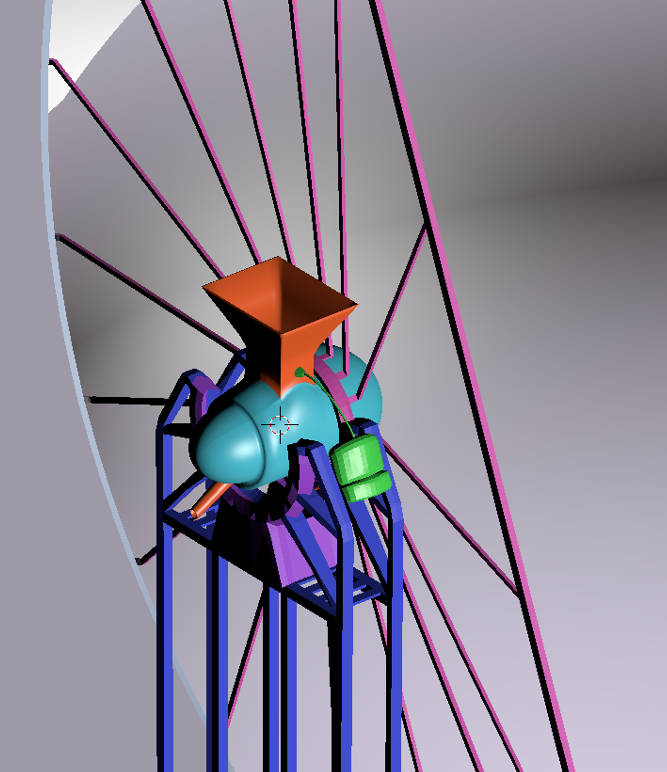
Here you can see the spout for emptying the contents of the tank, sticking out rather obscenely. It isn't really visible in the top image, in that version it sticks out of the part at the back of the tank. Who knows how many times a tank could be filled and emptied over one lunar day. As many times as possible would be the goal. Aside from where the limitations of the materials and resources fix that number, it might be good to leave the lava boiling for some time at an extra-hot temperature. Like yesterday's design, the goal here is to raise the temperature of the whole internal volume to at least 2500 Celsius, and sustain that temperature so the mix releases oxygen which can be collected.
Here is a small version from further away so you can see the whole thing. No fancy struts on the backs of the mirrors this time. Just imagine it has the same setup as the heliostats from yesterday.

-----------------------------------------------------------------------------
* of course reflective insulation would melt if it was actually in contact with the tank anywhere - the model doesn't show the separation because that was faster.
Components of Phase 1 VMC - The Lava Maker
(Note: the following is one of various posts that were copied here from the Moonwards.com forum for the sake of preserving the early days of the project. It was originally posted there on Oct 5th, 2015)

So here we have a convex parabolic mirror focusing light on a secondary concave parabolic mirror, which passes it to a third mirror as one semi-coherent beam, and that mirror sends it to the big crucible filled with regolith placed to one side. In the proportions shown here, the resulting beam of sunlight is concentrated by a factor of nearly 300. That might be too much. Heat dynamics is way beyond me, so the thermal concentration here may be fine, or it might melt everything even if it is made of a tungsten skin over a graphite interior and has a radiator on top (currently not shown). My guess is the 2nd option is more likely. The concentration factor can of course be adjusted to whatever works best. Still, the higher it can be pushed, the better, right?
The mirrors themselves could be a thick layer of aluminum to deal with the constant loss of aluminum from the surface due to its low vapor pressure. By circulating a liquid (a molten salt?) through channels in the graphite the heat could be used to turn a micro-turbine before being cooled in the radiator. Thus some use would made of it. Perhaps not worth the added complexity though. There is a microwave transmitter attached to the counterweight near the pivot of the whole thing in this model, which went with the idea the microturbine idea could be worth it. It passes the power generated to the crane for distribution.
The crucible holding the lava, by contrast, would be surrounded by reflective insulation (except where the light beam hits it) to limit heat loss. Its whole interior volume needs to reach 1500 Celsius at least to produce lava, and really the target is 2500 Celsius or more. At that temperature, oxygen can be produced in volume.
The idea of this configuration is to keep a volume of lava boiling away for an extended period of time. I think that is what is needed to have a process like oxygen production be effective. A cylinder that is say 1 unit wide by three high might also separate into layers over the night as its contents slowly cooled, right? Which would mean its different constituents could be separated and then processed further.
Components of Phase 1 VMC - the Tube Filler
(Note: the following is one of various posts that were copied here from the Moonwards.com forum for the sake of preserving the early days of the project. It was originally posted there on Oct 5th, 2015)

Okay, now that i've written the explanation of the dome under construction image that precedes this, this gizmo is already outdated. It's fine for when the dome wall is almost vertical, but as it curves inwards it becomes increasingly problematic. Which means the tubes should really be troughs, and the rods going across them should really be 3 pieces that are fused together when installed to form a sort of H shape, with angles created between the crossbar and the two outer rods that conforms to the angle of the dome at that height. Hm. I wonder if i have time to rebuild this. I'm a lot better at Blender than i was when i made it.
Anyhow, some of the principles still hold. The crane delivers loads of loose regolith to this moving trough placing mechanism. Fabric is dispensed from rolls on the front, welded together into one sheet as it rolls out using a gizmo at the front. Since it is made of basalt, welding the fabric is just a matter of two plates at just the right temperature pressing the cloth together as it passes through it, then cooling it so it is stable as it passes on. A spool of basalt cord is used to stitch the sides of the trough together. The vibrating drum won't really work because this trough is going to continuously get wider as the dome gets higher and the angles get closer to horizontal. Tampers usually work with a vibrating plate anyhow. So the system needs two or three of those, and they need to be on rails so they can travel back and forth across the width of the trough. That means boulders will need to be fused to this thing so its center of mass is in the right place and it is stable as it rolls along. And it will need to telescope to be ever wider as trough width widens with height.
Also a second rolling contraption will be needed i think. One that does detail work with the reinforcing rods after the filler passes. It needs to ensure that the joints between rods are strong, by reinforcing them with lava gobs, and it can add cross-bracing rods, forming Xs on the inner and outer facades between the Hs that traverse the thickness of the walls.
I complain a lot that i'm not getting things done as fast as i want to. This is a good example of why.
Components of Phase 1 VMC - Dome under construction
(Note: the following is one of various posts that were copied here from the Moonwards.com forum for the sake of preserving the early days of the project. It was originally posted there on Oct 5th, 2015)
These posts are rough drafts of what will go on the main page this week. It is crunch time now for the Lunar Exploration Analysis Group annual meeting, that i leave to attend in 2 weeks. I've been making models for the last few weeks, i'm not very good at it yet because i'm mostly learning as i go, but they are good enough to explain the main concepts.
This one comes first, a dome 40 meters across under construction

I have to figure out how to get the models to render better for these images. Anyhow...
This illustration shows a continuous tube construction system for the dome. It doesn't show the tube filling and placement system - but there is a model for that, it will go in the next post. So really the tubes that have been laid should be in a spiral, and the Tube Filler (i'm so tempted to give it some much funkier name*) should be visible trundling along, continuing to spiral upwards and inwards until the inward curve of the half-sphere being made reaches about 30 degrees. Then it is done and a different system is used to close off the remaining span, which would be about half the width and a fifth of the height.
That different system is illustrated in the roof structure of the - what, the foyer of the dome? That has 2 levels. The main level will eventually get airlocks in that doorway - which is about 3.5 m tall and 2 m wide, so equipment can be moved through it. The upper level is only connected to the dome interior and is pressurized when the whole thing is finished. The roof is sustained by the basalt beams at its corners. So the lava mold and melt-in-place operations need to produce those beams - (though narrower profiles could be placed at first and then built up with more lava troweled on when it is thick or spattered on when it is more viscous). Basalt cloth is stretched between those beams, a layer on the outside and a layer on the inside, and filled with regolith, tamped tight.
A heliostat is shown connected to the window. (It lacks some details, but the configuration is accurate. There are bits missing from the supports and the gear box and motor to turn it to track the sun aren't there. Also the smaller mirrors that transfer the light to the interior probably should have some thickness and mass to ensure they don't melt or deform - magnesia or graphite mass, chromium mirror surface, sapphire outer surface protecting the mirror surface?) It is large enough to fill the interior of the foyer with sunlight more intense than the full noon-day sun on Earth, all through the 2 weeks of lunar daylight. (Actually maybe i should scale it down a bit.)
Heliostats just like it, but bigger, would be attached to the main dome at the height where the tube filler finishes its job. One on the north side, and one on the south side. As Cernan's Promise is almost right on the equator, both would get full sun all day long. Pass the light from them into the dome and onto surfaces designed to scatter it throughout the dome. If those heliostats are sized to fill the dome with light as intense as full noon sun on earth, those scattering surfaces are going to heat up a great deal. So put channels in the basalt mass behind those surfaces, created when layers of lava are built up, put some water in them, and create a micro steam turbine system. Get electricity out of that heat, and spread it out too, making use of the dome's thermal mass to create an even warmth comfortable for people.
But that comes later and i really hope i have time to mock up a quick model of that stage before i leave, most of the elements are already done. Really i said that to get to the next point. The level where the tube filler stops is a convenient point to switch to building up lava facades on the inside and outside of the dome, and creating a strong ring of solid basalt at that height, and installing the heliostats there. The span that is open to the sky will help the lava to cool and properly solidify by the time the robots are ready to complete the cap of the dome. During that time lava has to be spread over the whole floor and built up to a good thickness.
The image shows the beginning of that process. First, tiles of lava are attached to the rods distributed between tube levels during placement. (Maybe they come from the melt-in-place lava facility, loose regolith that has been raked to remove chunks and smoothed level should melt evenly enough as a beam of concentrated sunlight is passed over it that tiles can be produced.) Inside and outside, the whole dome gets those tiles. Next, those tiles allow solid basalt to be built up. Lava can't be applied directly to the tubes, or the fabric will melt away and the regolith will fall out. But if the tiles deform a bit when lava is troweled over them it doesn't matter, they just have to allow the solid basalt portion to be unified so that a solid basalt dome builds up.
So as i've written this out i've thought of weaknesses and possible improvements, which is why i do it this way. I wanted to mock up this method first, but there are several ways this could be approached. Now that i've done this i'm not sure this is actually the fastest and most efficient way. Well, this is a process, after all. Onwards...
Subscribe to:
Posts (Atom)